Showing posts with label doctrine. Show all posts

Friday, 30 September 2016

Messengers of the Gospel - A Postscript

I had broadly planned my last blog post before the welcome weekend for new cadets. As it turned out, on the Sunday at WBC London, the UK Territorial Commander himself spoke of exactly what it means to be a Messenger of the Gospel. He too made clear that that should include all of us. Much of what he said stole any thunder from my forthcoming piece, which left me running the risk of looking like I was trying to steal his! Such is life. 

TC Clive Adams was as direct and to the point as I have ever heard him. Perhaps as direct and to the point as I have ever heard anyone in a major SA gathering. He summarised the gospel message, highlighting the gravity of the problem of sin (however much we don’t like using the word), the crippling, universal inability that sin means for us, the awful reality of hell, and the centrality and uniqueness of the cross-work of Jesus in atoning for our sin and opening the path to life. He was serious and he was sober and he was visibly moved. When he had finished there was a strong response in the hall, with extra chairs being needed to enlarge the mercy seat. 

My own reaction throughout his sermon was tears of relief and happiness to just hear the gospel. Here was the truth, presented with care and passion. It was thematic rather than expository, the themes unfolded with deliberate precision, firmness and love. The night before, I had actually said to Sarah that I was considering leaving the Army for lack of gospel clarity and hope; here was the very message to steady and encourage me. I wept with joy that anyone in a big SA gathering would publicly and strongly affirm the points he made. 

And it is that sense of surprise and relief that makes me write this postscript. With one arguable exception, at no point did he go a single doctrinal step beyond what every soldier and officer says they believe when they make their commitment and covenant. He proclaimed to cadets of the Salvation Army doctrines that they themselves will publicly affirm at their commissioning in two years, truths to which every soldier and officer in attendance has subscribed. And yet, what was striking was how out of the ordinary it was. And the fact that, alongside the widespread reactions of glad receptivity and personal commitment following from what he said, there was also a palpable undercurrent of shock and some negativity.

In the Salvation Army we have multiple belief streams. We have diverse approaches to truth coexisting, sometimes happily, sometimes with tensions, occasionally clashing severely. That diversity is perhaps more visible on Facebook than it usually is in major formal gatherings, but it is there nonetheless, and can surface. I’ve written before about the need to recognise that diversity, and to work out how to talk to one another within it. But for me, Saturday’s meeting highlighted two paradigm shifts with regard to doctrine that need to occur if the Salvation Army in the UK is to recover its role as an evangelistic, growing church. 

The first has to do with the nature of “Doctrine” in itself – or “The Doctrines” in themselves. I know that sometimes they are honoured as much in being ignored as being looked at; I've lost count of the number of Salvationists who have told me that there was a cursory or even dismissive discussion of the doctrines when they became soldiers. Or no discussion at all. 

And one gets the impression that when we do look seriously at doctrine, it tends to be primarily with a view to just such moments of transition. Doctrinal study occurs in preparation for our key steps of commitment – be it preparation of recruits for soldiership or cadets for commissioning. Approached like that, it is all too easy to see the doctrines as a static test, a one-off exam, a hurdle to be jumped. But doctrine is actually doctrine. It is the stuff we teach. It is a summary of our message. Doctrine is what we say, what we proclaim. It is an active, dynamic, exciting concept. “We who are being commissioned today are looking forward to getting these truths out into the communities which we serve.”

The trouble with the word “doctrine” is that for some reason it gives the impression of stuffy dustiness, of staticness. It is not only in TSA that “The Doctrines” are those old statements which are signed ‘at the beginning’ and never more referred to. But that isn't and can't be and mustn't be the case for any church. We should be saying, “Here is the centre of our message!” This is what we talk about, what we proclaim: God in his glory, his Word in its authority, his Son in his wonderful person and atoning work, his Spirit and his holy-making transformation, the eternal urgency of it all. When a senior officer proclaims the doctrines of the Salvation Army at a welcome service for new cadets, and that is cause for remark or even complaint, it does leave you wondering what he is supposed to be preaching!  We need to recover the Doctrines as Message, as Teaching and Preaching synopsis.

The other paradigm shift that is needed is to accept that the Salvation Army doctrines are a statement of specifically evangelical doctrine. Actually, they are a statement of a subset of evangelical doctrine; the eleven sections are a description of specifically Wesleyan belief and exclude evangelicals of other streams. They are more restrictive than the breadth of Evangelicalism, and deliberately so. 

Now, one of the oddities in Salvation Army theological circles is the frequent affirmation that the opposite is the case.  It is said that the doctrines were always very flexible, very broad, very accepting. The implication is that our statement is actually wider than evangelical doctrine. Indeed, despite the Army’s own self-description as an “Evangelical part of the Christian Church” (see, e.g. here), it seems fairly common to show disdain even towards the word evangelical. Given the awful mess the term finds itself in through association with Trumpery and the like in the USA, I can empathise, but historically there is no doubt that our doctrines position us squarely in one specific part of the movement called evangelicalism. 


The view we need to recover can be shown diagrammatically like this: against the backdrop of all the “non-evangelical” options out there, evangelicalism classically defines itself in terms of its beliefs. Salvationism, with its roots in the Methodist New Connexion, is a narrower subset within the evangelical family. Anyone coming to the SA doctrines with previous experience of the great, detailed, 17th century confessions (Westminster, Savoy, London), and then of the short 19th and 20th century doctrinal bases of the evangelical movement (EA, IVF, WEC, OMF etc) would immediately recognise the SA statement as falling into the pattern of the latter group. They would also quickly spot that we have a distinct Wesleyan slant that has deliberately excluded Calvinists, who would be welcome alongside Arminians in the other evangelical bodies. 


In contrast to this, a common view at present is shown in the second diagram. What is frequently implied, or even explicitly stated, is that the Doctrines are somehow wider and more flexible than evangelicalism, taking in views that would certainly be regarded as non-evangelical historically and at present. 

That the first diagram corresponds accurately to our historic and present identity is borne out by the excellent introduction to our Handbook of Doctrine:

Our doctrinal statement, then, derives from the teaching of John Wesley and the evangelical awakening of the 18th and 19th centuries. While there was significant correspondence between evangelicals in the mid-19th century, indicated especially in the nine-point statement of the Evangelical Alliance of 1846, the distinctives of Salvation Army doctrine came from Methodism. The Salvation Army Handbook Of Doctrine Page xviii

The tendency to emphasise the breadth and liberty implicit in the doctrines often leads to discussing them with an emphasis on flexibility and diversity of interpretation rather than from the standpoint of definite and clear shared truth. Sometimes one feels that the driving motive for this claimed flexibility is precisely the accommodation of non-evangelical views while “affirming” the doctrines. Beliefs that the SA founders were deliberately and explicitly excluding are now accepted as falling within the range permitted by a new, elastic reading of the founders' words. It is that reading which is an innovation, and insofar as it seems to permit people to say they believe the doctrines while actually believing something else, it is a danger to the movement. 

This may have been one motive for any angst at the TC’s sermon; by appearing to foreclose the question of “flexibility” through affirming the doctrines, he seemed to make that elasticity and the whole business of “exploring interpretations” look redundant, or worse.  Certainly, what he had to say entered into sharp confrontation with simple unbelief. I cannot forget being told “No one believes those crazy doctrines!” by an SA employee some years ago; however much that statement came out of immaturity and the desire to shock, I think it was a manifestation of a mindset with which the TC came into conflict at the welcome weekend.

I know I am an oddity in TSA. I can’t even sign the doctrines myself! But I am honest about that, and I don’t sign them. And I am trying to honour them. And I don’t think I am alone in longing for one thing, and one thing alone, to dominate again in our church – we want Jesus and his gospel. We long to hear about God and his creation and our fall into sin, and new hope through his Kingdom coming in Jesus. We long to hear about Jesus’ life and kindness and wisdom and death and resurrection and the coming of his Spirit. We long to hear about repentance and faith and assurance and growth and holiness and hope and homecoming. We long to hear about heaven and hell. We long for the old, old story. We long for a message which is recognisably the message of our Founders. We long for Blood and Fire – the atoning work of Christ, preached in the power of the Spirit.


That is what God gave us through the TC last Saturday night. We don’t yet know whether the hardest task for the Messengers of the Gospel is going to be to go on preaching the authentic message when they are ridiculed by the world... or ridiculed by the church. But until the headline “Territorial Commander Affirms the Doctrines at Cadetsʼ Welcome; All Present Agree Fully” sounds a bit less Babylon Bee, I fear that it may be the latter.

Tuesday, 19 July 2016

Doctrine versus practice?

Mark 3:20-35 NIV
20Then Jesus entered a house, and again a crowd gathered, so that he and his disciples were not even able to eat. 21When his family heard about this, they went to take charge of him, for they said, “He is out of his mind.”
22 And the teachers of the law who came down from Jerusalem said, “He is possessed by Beelzebul! By the prince of demons he is driving out demons.”
23So Jesus called them over to him and began to speak to them in parables: “How can Satan drive out Satan? 24If a kingdom is divided against itself, that kingdom cannot stand. 25If a house is divided against itself, that house cannot stand. 26And if Satan opposes himself and is divided, he cannot stand; his end has come. 27In fact, no one can enter a strong man’s house without first tying him up. Then he can plunder the strong man’s house. 28Truly I tell you, people can be forgiven all their sins and every slander they utter, 29but whoever blasphemes against the Holy Spirit will never be forgiven; they are guilty of an eternal sin.”
30He said this because they were saying, “He has an impure spirit.”
31Then Jesus’ mother and brothers arrived. Standing outside, they sent someone in to call him. 32A crowd was sitting around him, and they told him, “Your mother and brothers are outside looking for you.”
33“Who are my mother and my brothers?” he asked.
34Then he looked at those seated in a circle around him and said, “Here are my mother and my brothers! 35Whoever does God’s will is my brother and sister and mother.”


Mark chapter 3 gives us a first watershed moment in the tensions that surrounded Jesus early on in his ministry. Teaching and miracle-working are not neutral activities; people will want to own you or disown you, and both reactions are dangerous. In this passage – a typical "Marcan sandwich" – we see the family of Jesus coming to "take ownership" of him, followed by a section on the official teachers' opinion of him, and closing with the actual arrival of Jesus' relatives. The final words, "Whoever does God’s will is my brother and sister and mother" are seen by some as a strong call to correct practice as over against the sterile theologising of the intellectual authorities in Jerusalem. Is that right? 
The passage is, of course, a notorious one for its central difficulty: the teaching on blasphemy against the Holy Spirit. But it is that difficulty that gives the lie to the idea that "it's not what you think or say, but how you live, that matters."  
Jesus' family think he's mad. That may have its roots in genuine concern for his wellbeing, as his life seems overwhelmed by so many demands that he and his inner circle can't even eat. However, the language of "madness" and of "taking charge" shows a mix of lack of understanding and a paternalistic sense of ownership. Perhaps there is also a desire for the kudos that comes from that ownership being seen and admired. Whatever their motives, they are not 'reading' Jesus right. They have not understood, and are acting/reacting in ways that reveal their non-understanding. 
As for the teachers of the law from Jerusalem, their opinion is just perverse, as Jesus shows in his sequence of 'kingdom' and 'house' sayings. When they say that Jesus is possessed by the devil, they are deliberately, obtusely, wilfully, wickedly refusing any openness to the most obvious explanation of Jesus’ ministry: he is the Strong Man from God who has come to destroy the Evil One and all his works. Such a deliberately obtuse refusal to countenance the truth about Jesus is blasphemy against the Holy Spirit; it is a locking of the door against the gospel and against any hope of salvation. 
When Jesus is told that his family has arrived outside the building, his reaction seems cool, even harsh. This is not the only time that he reacts with apparent coldness or rebuke when people close to him get things badly wrong about who he is or about his purposes. "Who really is my family?" he asks. 

And he looks at those sat round him and says, "Whoever does God’s will is my brother and sister and mother.” And out of context, that might seem to say that right living is all there is to it. But how do we do God's will? How do we understand it? How do we hear it? 

The key is to see who he is speaking to. The Greek construction is so emphatic and repetitive it is almost funny – he looked around him at those seated in a circle around him. Here are the people who are recognising him for who he is, and having recognised him, are soaking up his words. They are physically close to Jesus, gathered round him, because they have seen something in him, love him and want to hear him. And of course, when we take that emphasis on the “gathered circle” seriously, Jesus’ words at this point are a breath-taking statement of who he is. “Who is my family? Those who do God’s will – which starts with listening to me!” He is either appallingly insane, arrogant, or the revelation of God.

Here is a world where those who should know better through the closeness of family life or the depth of theological training and privilege are dismissing Jesus as mad or demonic. But in that world some people recognise him for who he is and are listening to his every word. Recognition of Jesus as the Strong One who comes from God, and therefore careful attention to his words as being the revelation of the will of God – these are the prerequisites for doing the will of God. Doing God’s will is essential – it is the mark of the Family – and it starts with truth about Jesus. Obedience to the will of God starts with right thinking about his Son. Right thinking makes us listen to Jesus in humility as he describes himself and his work, and thus how we should live. Being in Jesus’ family IS good theology being worked out in practice. And as the gospel of Mark goes on, right living is spelled out in ever stronger and clearer terms – and always in relation to the person of Christ and the nature of his death as a ransom.

There is a tide of hatred towards orthodox thinking that loves to pit doctrine and praxis against each other. Such talk has the aim of preserving Christianity and carrying it forward in the post-modern and post-post-modern generation. But it is as wrong-headed and destructive as “He is mad!” or “He is of Satan!” No one can truly love and live for God and despise the Son he has sent or the work that he achieved through him. Doctrine and life are twins – Siamese twins – inseparable and interwoven. Despise either and you will kill both.

Recognise Jesus, love his person, his words and his work, walk in his ways, and you can be assured: You are part of his family, now and forever!


Friday, 4 December 2015

The Awfully Big Adventure of being a Traditional Christian


Society is changing. That is a truism because that is what society does. Hairstyles and fashions come and go – one generation’s cutting edge is another generation’s ridiculous. Ideas and philosophies wax and wane in the same way: perhaps in longer cycles, but with just as finite a life span as a mullet or crepe shoes. 
 
I think it was William Inge who said, “Whoever marries the spirit of this age will find himself a widower in the next.” Despite this wisdom from the good Dean, the church has always had at least a wing that has been determined to cosy up to the latest wave of
fashionable thought. 

In fact, society, even at its most Christian-influenced, is always going to be in tension with the church. In its thought-life it will be in conflict with God’s revelation. The swirling and apparently chaotic currents of politics and human thought can be summed up as “the heathen raging and the peoples imagining a vain thing” – a superficially confused and meaningless roar of white noise that in reality has one thread running through it – opposition to God and his Messiah. The church’s role is to provide a prophetic voice that challenges society in that rebellion. 

Charles Finney
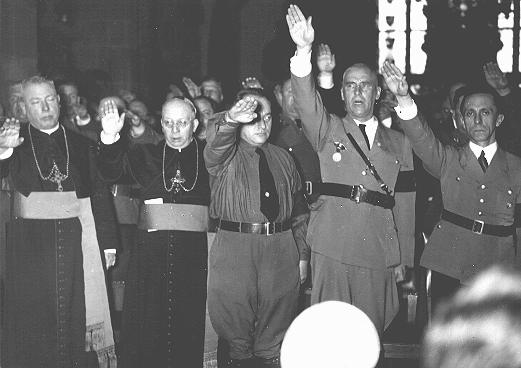
When the church – or parts of it – capitulate to the zeitgeist philosophically and ethically, the church loses any possibility of maintaining that prophetic role. This has happened time after time, in one way or another. The grafting in of imperial power structures and pagan practices into the church through and after Constantine emasculated us for centuries. The Protestant Reformation both benefitted from and was compromised by Renaissance humanism and the political and personal desire of kings and princes to loosen the authority of the Roman see. Finney’s methodologically driven individualistic Arminianism fitted just too neatly into the new American Dream where the salesman was king.  And many churches failed to see that 
Churchmen with Nazi leaders 
the hopes of German renewal offered by the National Socialists in the 30s were utterly incompatible with the gospel; their compromise has damaged the impact of some denominations to this day. 

In all of these cases, I think the church would have claimed to be culturally relevant, to be moving with the times, to be at the cutting edge, to be maintaining its prophetic voice. And in every case we can now discern, with hindsight, the damage that was done and the weaknesses that were left. 

Over the last decade the pace of change in the West feels as if it has picked up. Ideology which was creeping in through the humanities departments of the universities when I was an undergraduate is now quite suddenly dominant. As a Biology undergraduate at the turn of the 80s I lived in a staunchly Modern world. The heroes were Dawkins and Maynard-Smith – and if as a Christian with qualms about evolution you found them to be villains, you knew exactly what weapons you needed to fight them. But right back then, very strange things were being said by my friends studying sociology and social anthropology which I simply couldn’t get a handle on. Truth is all relative?? What is true in one culture is not true in another? The meaning of  a book is defined by the reader, not the author?? Frankly, it seemed crazy, utterly stupid, nonsense. I was a thoroughly Modern man. (And still, to be honest, feel most comfortable when the discussion is controlled by those presuppositions.)

John Maynard Smith
But it is that Postmodern, relativist stream which now dominates our society, our culture, our media. Dawkins is a dinosaur, a representative of a bygone age. I’d still watch his teeth, but he is by no means a great force. No, the big issue is the dominance of the Relative. We are no longer modern, we are post-modern.  

And the church, of course, is tempted to buy into that. Given that society is ever less patient with absolutism and certainty, it is not hard to sense the potential “benefit” of running with that. In a world which rejects any idea of an overarching metanarrative, the church now says it’s wrong to see such an overarching narrative even in the Bible itself. In a world where sexuality has been utterly privatised, with behaviour and identity infinitely malleable, the church says that sexual/gender inclusion has always been central to the gospel when properly understood. In a world where everything must be affirmed, where all must have prizes, where negativity is the only negative, the church says that the gospel is one of self-realisation, that ultimately God's Love utterly dissolves every barrier, and that there is no hell to flee, because all will ultimately be gathered home. 

And, of course, such belief is always put forward as being brave and bold. Those who espouse the new approach are always ‘cutting edge’. They are always ‘reaching those the traditional church has failed’, they are ‘making a safe space for questioning people’, they are touching the lives of those who have been mistreated or marginalised by more restrictive forms. Traditional Christianity, on the other hand, is seen as staid, closed-minded, boring, harsh, irrelevant – a cause of the problems we face, not their solution. 

I want to challenge this. I want to challenge it because the post-modern wave will pass in its turn, and the church that has embraced it so passionately will be left a widower once again. But I also want to challenge it because it is nonsense. It is not the traditional stream of orthodox Christianity that is spineless, boring and unadventurous. The exact opposite is the case. 

There is nothing so boring and predictable and ultimately self-indulgent as “Christianity” when it ends up simply absorbing the zeitgeist, and not least because the church never does it as well as the world. But also because in the name of boldness, the church becomes just another yes-man, the culture’s parrot, squawking along to the current trend. It’s all so predictable! And tragically, the world finds it laughable – do you remember Not the Nine O’clock news and the CofE Satanists sketch
 
By contrast, standing for classic doctrinal orthodoxy, for belief in the inspiration and authority of scripture, for the uniqueness of Jesus in his person and work, for the reality of the future justice that he will bring when he returns, for a view of sexuality and marriage that has come to be hated and even outlawed, for the absolute need each of us has of personal regeneration, transformation through the direct working in us of the Spirit of God – believing and proclaiming such things is actually very scary. It requires real courage.  

We are entering a time in which it is very easy to imagine Christian pastors being reported to the police by members of their own congregations for things said in the pulpit. There is a great deal of hate and malevolence in our supposedly tolerant culture and, be assured, it will drive massive wedges into the church too. At such a time, thinking and speaking classic doctrine and classic morality takes a lot of nerve. And faith. 

The challenge is on. I have blown it in the past, destroying my ministry through spiritual coolness and moral failure. I don’t want to blow it again, through simply chickening out. I don’t have a public preaching ministry any more, but I know I must do what I can, which is write and agitate. Will you join the movement? :-) 

Terry Heyward on A Chralaig
The Salvation Army and the church in the West as a whole need adventurers. It needs bold compassionate people who will speak the truth in love.  People for whom the gracious welcome of a gospel-driven church is authentic and Christ-like. They do not deny the reality of sin, nor put grace and the challenge to repent into a false opposition. They know that Jesus tackled the would-be stoners of the adulterous woman ruthlessly, and spoke to her in firm kindness, “Go, and sin no more.”  That is Christ-shaped, bold grace. It is scary, because it offends both pharisaic-church and worldly-church, but it is good. So good.

The church needs people who will resist the incursion of the spirit of the age. People who will say No to making the gospel easier to believe, because they know that the gospel is always impossible to believe anyway. People who will not confuse resistance to the spirit of the age with simple conservatism, mind you, still less a hankering after the spirit of the previous age. (Vague, amorphous, viciously tolerant postmodernity is not necessarily any worse overall than spiky, proud, pushy modernity – it just has different points of weakness and rebellion.) 

The church needs prophets. It needs to learn again to raise its voice in gospel proclamation. I do not see Elijah on Carmel making a safe space for spiritual exploration, I do not hear Paul in Athens affirming the whole variety of spiritual experience. And I don’t imagine that the married monk of Wittenberg, or Wesley at Bristol, or Booth in Whitechapel were a particularly cosy listen. If the church is to proclaim the Living God and his Son, sent to save us, it will not be or feel particularly safe. I’m sorry folks, but we need to be a bit less Michael Mcintyre, and a bit more Stewart Lee.

John Wesley preaching
The church – in my own context the Salvation Army – needs leaders who will be brave and bold regarding the doctrines and moral positions of the church. Clearly, leading an international movement of this size is an appalling responsibility and an impossible challenge. The fact of our interaction with government and social services makes this no easier – arguably it makes fatal compromise almost inevitable. I do not envy the leaders’ role! But it is right to place the challenge – doctrinal incoherence and moral equivocation will not take the movement forward, and nor are they loving. Allowing the teaching of positions that directly contradict (for instance) doctrine 11 may seem gracious and kind, but actually it betrays every supporter who gives towards the army’s ministry in the expectation that the doctrines will be upheld. The dream of an “inclusive church” which refuses to call out sexual sin is very cruel and unloving towards the person who struggles with particular temptations and has the right to expect the church to give support in that struggle. Failing to call to repentance is not loving – it is a dereliction of duty that hurts people, now and eternally. 

We are in an adventure, folks, and it is going to be a wild ride. The bold path, the daring, courageous way ahead, clings to the line of God’s truth while every wind of changing culture tries to blow us off course. We will stick to the eternally relevant word even as fellow Christians scorn our “irrelevance". We will not be traditional for the sake of it – we long to see more light shining from the Word – but we do not see any light at all where the Word itself is despised. 

G K Chesterton
I do not follow Chesterton in every last detail of this famous piece from his book Orthodoxy, but the overall argument is stunning, and we need to recover it: 

 
…it is exactly this which explains what is so inexplicable to all the modern critics of the history of Christianity. I mean the monstrous wars about small points of theology, the earthquakes of emotion about a gesture or a word. It was only a matter of an inch; but an inch is everything when you are balancing. The Church could not afford to swerve a hair's breadth on some things if she was to continue her great and daring experiment of the irregular equilibrium. Once let one idea become less powerful and some other idea would become too powerful. It was no flock of sheep the Christian shepherd was leading, but a herd of bulls and tigers, of terrible ideals and devouring doctrines, each one of them strong enough to turn to a false religion and lay waste the world. Remember that the Church went in specifically for dangerous ideas; she was a lion tamer. The idea of birth through a Holy Spirit, of the death of a divine being, of the forgiveness of sins, or the fulfilment of prophecies, are ideas which, anyone can see, need but a touch to turn them into something blasphemous or ferocious. The smallest link was let drop by the artificers of the Mediterranean, and the lion of ancestral pessimism burst his chain in the forgotten forests of the north. Of these theological equalisations I have to speak afterwards. Here it is enough to notice that if some small mistake were made in doctrine, huge blunders might be made in human happiness. A sentence phrased wrong about the nature of symbolism would have broken all the best statues in Europe. A slip in the definitions might stop all the dances; might wither all the Christmas trees or break all the Easter eggs. Doctrines had to be defined within strict limits, even in order that man might enjoy general human liberties. The Church had to be careful, if only that the world might be careless.
  
This is the thrilling romance of Orthodoxy. People have fallen into a foolish habit of speaking of orthodoxy as something heavy, humdrum, and safe. There never was anything so perilous or so exciting as orthodoxy. It was sanity: and to be sane is more dramatic than to be mad. It was the equilibrium of a man behind madly rushing horses, seeming to stoop this way and to sway that, yet in every attitude having the grace of statuary and the accuracy of arithmetic. The Church in its early days went fierce and fast with any warhorse; yet it is utterly unhistoric to say that she merely went mad along one idea, like a vulgar fanaticism. She swerved to left and right, so exactly as to avoid enormous obstacles. She left on one hand the huge bulk of Arianism, buttressed by all the worldly powers to make Christianity too worldly. The next instant she was swerving to avoid an orientalism, which would have made it too unworldly. The orthodox Church never took the tame course or accepted the conventions; the orthodox Church was never respectable. It would have been easier to have accepted the earthly power of the Arians. It would have been easy, in the Calvinistic seventeenth century, to fall into the bottomless pit of predestination. It is easy to be a madman: it is easy to be a heretic. It is always easy to let the age have its head; the difficult thing is to keep one's own. It is always easy to be a modernist; as it is easy to be a snob. To have fallen into any of those open traps of error and exaggeration which fashion after fashion and sect after sect set along the historic path of Christendom--that would indeed have been simple. It is always simple to fall; there are an infinity of angles at which one falls, only one at which one stands. To have fallen into any one of the fads from Gnosticism to Christian Science would indeed have been obvious and tame. But to have avoided them all has been one whirling adventure; and in my vision the heavenly chariot flies thundering through the ages, the dull heresies sprawling and prostrate, the wild truth reeling but erect.

Saturday, 31 October 2015

Fellowship in the truth


That which was from the beginning, which we have heard, which we have seen with our eyes, which we have looked at and our hands have touched—this we proclaim concerning the Word of life. The life appeared; we have seen it and testify to it, and we proclaim to you the eternal life, which was with the Father and has appeared to us. We proclaim to you what we have seen and heard, so that you also may have fellowship with us. And our fellowship is with the Father and with his Son, Jesus Christ. We write this to make our joy complete.

So begins John in his first letter. Much could be and has been said about those verses. The one thing that struck me this morning is how fellowship (with God and with one another) is based in truth, in facts. Things heard, seen, witnessed, touched, believed, proclaimed, written - these are the foundations of togetherness in the Kingdom. 

We live in a world where truth-that-can-be-written is derided as the foundation only for hatred and war. To experience love, we are told, we need to flee from the Objective, the Absolute. John seems to say exactly the opposite. 

And that chimes with my experience. Over the last year I can think of a number of moments of meeting with Christians, both old friends and completely new to me, where the existence of a common foundation in the gospel was either the presupposition for the meeting, or quickly became apparent in the course of conversation. Such moments have been deeply moving and a source of thankfulness. On the other hand, I have also had experiences of 'Christian' events where the commitment to the Subjective, the rejection of objective doctrinal agreement or of verbal revelation itself, strangles fellowship at birth.

Our fellowship is in the Truth. Our fellowship is in Him - the one who came, was heard, was seen, who died for our sins, who rose again for our justification, who is seated at the right hand of the Father, who has poured out the Holy Spirit, who is being proclaimed amongst the nations, who will come again to judge the living and the dead. These truths about our Lord Jesus are objective, speakable, writeable, shareable. These truths are precious to us for he is precious to us. And where there is agreement in these truths, there is fellowship, light and joy. 

Thursday, 17 September 2015

Some curious thoughts about Kim Davis


If fame is only supposed to last fifteen minutes, Kim Davis seems to have stayed slightly longer in the limelight than is necessary. The Kentucky clerk jailed for refusing marriage licenses to gay couples has now been with us for that number of days and the media interest is only just beginning to wane. 

I have found her case interesting for a number of reasons. She is not a neat poster girl for her cause. Married four times, a life-long and highly committed Democrat, she may not be the religious right's ideal standard bearer in their fight. 

But one issue particularly strikes me, in terms of "Christian culture." Davis is a fairly recent convert to her church - about four years - and it is the nature of that church which fascinates. 

She is a member of Solid Rock Apostolic Church. Splitting from other Pentecostal groupings back near the beginnings of the movement, this particular "apostolic church" does not believe in the Trinity and regards speaking in tongues as necessary to salvation. On both those grounds it is clearly not a Christian church - although, as with other confused and heretical groups, it is not our place to assess the possibility or probability of personal faith among its members. 

What intrigues me is the speed with which some Christians have identified with this "Christian" lady. Would support have been as swift if she had been a denier of the trinity who went to the Kingdom Hall and thought that evangelistic door knocking was essential for salvation? Would the evangelical right have been as warm if she had denied the trinity, worn a burkha and just come back from the hajj? 

And the support from like-minded Christians has been uniform in taking Kim Davis to be one of them. In an era of instant reactions, of shallow knee-jerking, of single-issue blinkeredness, of lack of theological awareness, haven't we been reduced to the point where doctrinal definition is irrelevant? If a woman is white and doesn't like gay marriage, she must be sound, right? 

I'm not commenting on Kim Davis' conscience. Nor the rights and wrongs of her specific concern - not to have her name on those certificates. Nor the fact that she (inadvertently, and because of media spin, perhaps) seems to have done more to spur on public acceptance of SSM in the U.S. than any other single individual. I'm just saying that her case highlights the low point we have reached in understanding our own faith. When the choice is between bright and loving but fuzzy liberals, and unattractive evangelicals who have lost touch with the basic contours of their own faith, no wonder it is the atheists and the Moslems who are laughing. 

Sunday, 1 February 2015

Anyone for Total Depravity?

The Doctrines of the Salvation Army were the Founders' attempt at expressing their core beliefs in such a way as to summarise the Army's message, invite Christians who shared their vision of the gospel to identify with the movement, and to ward off those whose vision was significantly different at what they saw as key points. They are still, unaltered, the doctrinal standard of TSA, to which all soldiers and officers must subscribe. It is because of one or two such differences with the doctrines that I have stopped at being an Adherent rather than becoming a Soldier, but I would not be an Adherent if I didn't recognise in the Doctrines a fair summary of authentic Christianity, a preachable faith which has led many to love Christ as he really is. 

Some of my wife's students (cadets at William Booth College) were looking at the doctrine of Total Depravity last term, and I got into some significant conversations and personal study on the topic. Some I wrote up on another blog; I have plundered and edited some of that material in what follows. This doctrine is absolutely foundational for Christians - accepted as catholic (universal and orthodox) doctrine ever since Pelagius' controversy. And it has far-reaching consequences - as my daughter said to me recently regarding a theology course she is taking, she has come to realise that, after the doctrine of God, the doctrine of sin is all-important. 

The Salvation Army's statement on sin, which includes direct reference to Total Depravity, runs like this:

We believe that our first parents were created in a state of innocency, but by their disobedience they lost their purity and happiness, and that in consequence of their fall all men have become sinners, totally depraved, and as such are justly exposed to the wrath of God.

The Doctrine itself 

The doctrine of Total Depravity does not say that we are all as bad we could possibly be, but that there is an all-pervasive quality to our sin which mars every aspect of our nature, making us totally bankrupt and incompetent when it comes to dealing with God. 

It is not only our worst moments, our open, blatant, high-handed sins, that are expressions of our sinfulness. Even our best, our highest efforts, our attempts at reform or even at religion, are spoiled and rendered valueless by our sin. As Isaiah put it, our righteousness is like filthy rags. 

The doctrine of total depravity says that sin has affected everything, and that includes our consciousness of sin. It says that we can't see how bad we are. It says that, as we face the oncoming disaster referred to in the phrase "justly exposed to the wrath of God" we are, by our fallen nature, unaware of our peril. We are asleep in a burning house, and it is a drugged sleep. Or to use a more biblical image, we are "dead in our sins"; a dead person doesn't even know they're dead.  


The repercussions of the doctrine

1) This Christian doctrine anchors our idea of grace within the Christian faith. 

It is against the backdrop of this deep view of sin that the Christian gospel says three things, or one thing with three elements:

  • Where we are unable and bankrupt, God is able and active. His grace is extended to us - what we cannot do, he will do - he treats us in a way we have not deserved and cannot deserve. Our only hope lies not in what we do but in his grace and kindness - we can only throw ourselves on his mercy. This insight in itself marks out Christianity amongst the world's religions.

  • God's grace comes to us specifically through the person of Jesus Christ. His obedient life, his submissive death, his resurrection - these are the events in which God's grace is worked out for us. Grace reaches us in life, in time and space because grace has reached down into time and space - ours is a historical faith.

  • God's grace in the once-and-for-all work of Christ can only be grasped because of the gracious work of the Spirit, whose awakening power is needed if we are even to perceive our need of Jesus. Like the dry bones in the valley, we need God's breath upon us so that we come alive to our spiritual need, and his spiritual provision.  

We have to grasp the depth of the badness in order to see the greatness of God's goodness. Imagine that two people are rescued from a house fire.  One insists, "Oh, it was no big deal - I could have got out of there on my own" but the other says, "Man - I was totally stuck! I was utterly lost; no way could I have saved myself!" Which one will appreciate and praise the rescuing fire crew the most? 

The fact is that we are asleep in the fire. A drugged sleep, no less. The doctrine of total depravity says that sin has affected everything, and that includes our consciousness of sin - it is only the fireman breaking graciously into the room that alerts us to the seriousness of the danger! 

Our understanding of grace is anchored at its top end, as it were, by the unspeakable marvel of God's love in Jesus Christ. But it is anchored at the bottom end by our view of the sinfulness of human nature. A serious view of sin leads to a big view of Christ and a breathtaking insight into the love of God.
 

2) This Christian doctrine is unique among world religions

The doctrine of Total Depravity sets Christianity apart from all other religions. In fact, it is starting from this point that it becomes clear that Christianity is not, in the normal sense, a "religion" at all! While religion urges us to do this and do that in order to reach up to God, on the presupposition that what we can do will be enough, or at least make some significant difference, the Christian message is that our sin so weighs us down, so blocks us out from God, that there is nothing we can do by way of ritual action, social good or internal spiritual exercise that can possibly deal with the gravity of our problem and even start to bring us into the presence of our Creator. And for good measure it tells us that we are blinded to the degree of our sinfulness and have no natural awareness of the depth of our problem! This is the most pessimistic world-view of any faith.

If grace is a religious rarity, historical grace to the totally unable is unique. While religion always ends up saying "DO", God in Christ says "DONE". And it says this to those who don't even yet know their need. To the dead it says, "Live!"


3) This Christian doctrine stands over against our contemporary, human-centred culture.

We live in a self absorbed, self-pampering, self-congratulating age. Christian pessimism about human nature is utterly at odds with our generation's crazy optimism. (It is crazy because the evidence that ought to explode it flows in with every day's news!) 

Unsurprisingly, there are plenty of versions of spirituality currently available on the supermarket shelves of faith which adopt contemporary thinking rather than Christian doctrine as their template. Just to take one sentence from a popular "spiritual" website:

At the core of each life is true, eternal goodness—and the key to a successful life is opening up that true self so that we can compassionately connect with God’s world.

Although this is totally incompatible with the SA doctrine and that of other Christian churches, such thinking is really pretty common in Christian circles today. It stems partly from a confusion about the nature of God's love; for a generation for whom romantic and sexual categories have become all-pervasive and exclusive when speaking of love, it becomes natural to say that "God was so in love with us that he came to earth so as to be with us". But it is horribly unbiblical and destructive of the gospel. Our doctrinal statement ought to be all the exclusion required. After all, the idea that we are all fundamentally good is in itself a demonstration of the blindness that sin has brought about; to bring this idea into the church is, to say the least, not a very good idea.

Nowhere is this clash with contemporary culture more acute over the last twenty years or so than in the great debate regarding sexual ethics.

The idea of a "fallen world" is hardly dominant in contemporary thought about human medical, psychological or sexual issues. The general assumption is that what is, is what is meant to be - or at least, given that nothing is "meant to be", as if it had a mind behind it, nothing can be said to have ceased to be what it was meant to be. As a result, we are not permitted to critique any aspect of innate human desire or behaviour on the basis of a concept of fallenness. And this dominant attitude in the world is now frequently found in the church.

The result of this is that the phrase "God made me this way" is used as a catch-all defence regarding all manner of moral issues. The doctrine of Total Depravity just won't let us do that, and yet, through ignorance or rejection of the doctrine, people are driving a coach and horses through classical Christian morality with the phrase. 

The doctrine of Total Depravity says that our world has entered into rebellion and madness; it has slipped away from the ideal. In the place of order and harmony and regularity is disorder and twistedness and loss of equilibrium. In such a world, my desires cannot be trusted. I cannot simply say, "God made me this way" when it would also be true to say, "Sin made me this way."

I have read a very sensitive blog which makes this very point. The writer is qualified to speak to one of the chief presenting issues today in a way which I am not. His comments remind us that, on some contemporary moral questions, it is the very heart of the Christian faith that is at stake. Not for nothing is the doctrine of sin under attack within the church. See here

*  *  *  *  *  *  *  *  *  *  *  *  *  *  * 

If I look for moral or spiritual compass bearings inside myself, I do not merely run the risk of being misled - I am sure to be misled! I need a word from outside, a word from God the Father that speaks to me where I am, tells me who I am, tells me what is right and tells me what is wrong. Above all, I need a word from outside that tells me of the Saviour who came from outside, and yet came as one of us, to bear our sin, attacking our depravity at root, and then, victorious, poured out the Holy Spirit. It is this Spirit who opens our eyes to who we are in sin and to the glory and sufficiency of Christ, and who transforms us from day to day into his likeness. 

I hope you are all up for Total Depravity. There is no hope without it.