
Society
is changing. That is a truism because that is what society does. Hairstyles
and fashions come and go – one generation’s cutting edge is another generation’s
ridiculous. Ideas and philosophies wax and wane in the same way: perhaps in
longer cycles, but with just as finite a life span as a mullet or crepe
shoes.
I
think it was William Inge who said, “Whoever marries the spirit of this age
will find himself a widower in the next.” Despite this wisdom from the good
Dean, the church has always had at least a wing that has been determined to cosy
up to the latest wave of
 fashionable thought.
When
the church – or parts of it – capitulate to the zeitgeist philosophically and
ethically, the church loses any possibility of maintaining that prophetic role.
This has happened time after time, in one way or another. The grafting in of
imperial power structures and pagan practices into the church through and after
Constantine emasculated us for centuries. The Protestant Reformation both
benefitted from and was compromised by Renaissance humanism and the political
and personal desire of kings and princes to loosen the authority of the Roman
see. Finney’s methodologically driven individualistic Arminianism fitted just
too neatly into the new American Dream where the salesman was king. And
many churches failed to see that
the hopes of German renewal offered by the
National Socialists in the 30s were utterly incompatible with the gospel; their
compromise has damaged the impact of some denominations to this day.

The
church – in my own context the Salvation Army – needs leaders who will be brave and
bold regarding the doctrines and moral positions of the church. Clearly,
leading an international movement of this size is an appalling responsibility and
an impossible challenge. The fact of our interaction with government and social
services makes this no easier – arguably it makes fatal compromise almost
inevitable. I do not envy the leaders’ role! But it is right to place the
challenge – doctrinal incoherence and moral equivocation will not take the
movement forward, and nor are they loving. Allowing the teaching of positions
that directly contradict (for instance) doctrine 11 may seem gracious and kind,
but actually it betrays every supporter who gives towards the army’s ministry
in the expectation that the doctrines will be upheld. The dream of an “inclusive
church” which refuses to call out sexual sin is very cruel and unloving towards
the person who struggles with particular temptations and has the right to
expect the church to give support in that struggle. Failing to call to
repentance is not loving – it is a dereliction of duty that hurts people, now
and eternally.

In
fact, society, even at its most Christian-influenced, is always going to be in
tension with the church. In its thought-life it will be in conflict with God’s
revelation. The swirling and apparently chaotic currents of politics and human thought can be summed
up as “the heathen raging and the peoples imagining a vain thing” – a superficially confused and meaningless roar of white noise that in reality has one
thread running through it – opposition to God and his Messiah. The church’s
role is to provide a prophetic voice that challenges society in that
rebellion.
 |
| Charles Finney |
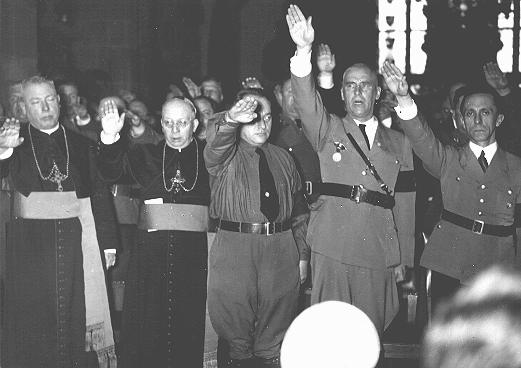 |
| Churchmen with Nazi leaders |
In
all of these cases, I think the church would have claimed to be culturally
relevant, to be moving with the times, to be at the cutting edge, to be
maintaining its prophetic voice. And in every case we can now discern, with
hindsight, the damage that was done and the weaknesses that were left.
Over
the last decade the pace of change in the West feels as if it has picked up.
Ideology which was creeping in through the humanities departments of the
universities when I was an undergraduate is now quite suddenly dominant. As a
Biology undergraduate at the turn of the 80s I lived in a staunchly Modern
world. The heroes were Dawkins and Maynard-Smith – and if as a Christian with
qualms about evolution you found them to be villains, you knew exactly what
weapons you needed to fight them. But right back then, very strange things were being said
by my friends studying sociology and social anthropology which I
simply couldn’t get a handle on. Truth is all relative?? What is true in one culture
is not true in another? The meaning of a book is defined by the reader, not the author?? Frankly, it seemed crazy, utterly stupid,
nonsense. I was a thoroughly Modern man. (And still, to be honest, feel most comfortable when the discussion is controlled by those presuppositions.)
 |
| John Maynard Smith |
But
it is that Postmodern, relativist stream which now dominates our society, our culture, our media.
Dawkins is a dinosaur, a representative of a bygone age. I’d still watch his
teeth, but he is by no means a great force. No, the big issue is the
dominance of the Relative. We are no longer modern, we are post-modern.
And
the church, of course, is tempted to buy into that. Given that society is ever
less patient with absolutism and certainty, it is not hard to sense the potential “benefit” of running with that. In
a world which rejects any idea of an overarching metanarrative, the church now
says it’s wrong to see such an overarching narrative even in the Bible itself. In a
world where sexuality has been utterly privatised, with behaviour and identity
infinitely malleable, the church says that sexual/gender inclusion has always been
central to the gospel when properly understood. In a world where everything must
be affirmed, where all must have prizes, where negativity is the only negative,
the church says that the gospel is one of self-realisation, that ultimately
God's Love utterly dissolves every barrier, and that there is no hell to flee,
because all will ultimately be gathered home.
And,
of course, such belief is always put forward as being brave and bold. Those who
espouse the new approach are always ‘cutting edge’. They are always ‘reaching
those the traditional church has failed’, they are ‘making a safe space for questioning
people’, they are touching the lives of those who have been mistreated or
marginalised by more restrictive forms. Traditional Christianity, on the other
hand, is seen as staid, closed-minded, boring, harsh, irrelevant – a cause of the
problems we face, not their solution.
I
want to challenge this. I want to challenge it because the post-modern wave
will pass in its turn, and the church that has embraced it so passionately will
be left a widower once again. But I also want to challenge it because it is nonsense.
It is not the traditional stream of orthodox Christianity that is spineless,
boring and unadventurous. The exact opposite is the case.

There
is nothing so boring and predictable and ultimately self-indulgent as “Christianity”
when it ends up simply absorbing the zeitgeist, and not least because the
church never does it as well as the world. But also because in the name of
boldness, the church becomes just another yes-man, the culture’s parrot,
squawking along to the current trend. It’s all so predictable! And
tragically, the world finds it laughable – do you remember Not the Nine O’clock news
and the CofE Satanists sketch?
By
contrast, standing for classic doctrinal orthodoxy, for belief in the
inspiration and authority of scripture, for the uniqueness of Jesus in his
person and work, for the reality of the future justice that he will bring when
he returns, for a view of sexuality and marriage that has come to be hated and
even outlawed, for the absolute need each of us has of personal regeneration,
transformation through the direct working in us of the Spirit of God – believing
and proclaiming such things is actually very scary. It requires real courage.
We
are entering a time in which it is very easy to imagine Christian pastors being
reported to the police by members of their own congregations for things said in
the pulpit. There is a great deal of hate and malevolence in our supposedly
tolerant culture and, be assured, it will drive massive wedges into the church
too. At such a time, thinking and speaking classic doctrine and classic
morality takes a lot of nerve. And faith.
The
challenge is on. I have blown it in the past, destroying my ministry through
spiritual coolness and moral failure. I don’t want to blow it again, through
simply chickening out. I don’t have a public preaching ministry any more, but I
know I must do what I can, which is write and agitate. Will you join the movement?
:-)
 |
| Terry Heyward on A Chralaig |
The
Salvation Army and the church in the West as a whole need adventurers. It needs
bold compassionate people who will speak the truth in love. People for
whom the gracious welcome of a gospel-driven church is authentic and Christ-like. They do not deny the reality of sin, nor put grace and the challenge to repent into a false opposition.
They know that Jesus tackled the would-be stoners of the adulterous woman ruthlessly, and
spoke to her in firm kindness, “Go, and sin no more.” That is
Christ-shaped, bold grace. It is scary, because it offends both pharisaic-church
and worldly-church, but it is good. So good.
The
church needs people who will resist the incursion of the spirit of the age.
People who will say No to making the gospel easier to believe, because they
know that the gospel is always impossible to believe anyway. People who will
not confuse resistance to the spirit of the age with simple conservatism, mind you,
still less a hankering after the spirit of the previous age. (Vague, amorphous,
viciously tolerant postmodernity is not necessarily any worse overall than
spiky, proud, pushy modernity – it just has different points of weakness and
rebellion.)
The
church needs prophets. It needs to learn again to raise its voice in gospel proclamation.
I do not see Elijah on Carmel making a safe space for spiritual exploration, I
do not hear Paul in Athens affirming the whole variety of spiritual experience.
And I don’t imagine that the married monk of Wittenberg, or Wesley at Bristol, or Booth
in Whitechapel were a particularly cosy listen. If the church is to proclaim
the Living God and his Son, sent to save us, it will not be or feel particularly
safe. I’m sorry folks, but we need to be a bit less Michael Mcintyre, and a bit
more Stewart Lee.
 |
| John Wesley preaching |
We
are in an adventure, folks, and it is going to be a wild ride. The bold path,
the daring, courageous way ahead, clings to the line of God’s truth while every
wind of changing culture tries to blow us off course. We will stick to the
eternally relevant word even as fellow Christians scorn our “irrelevance".
We will not be traditional for the sake of it – we long to see more light
shining from the Word – but we do not see any light at all where the Word
itself is despised.
 |
| G K Chesterton |
I
do not follow Chesterton in every last detail of this famous piece from his
book Orthodoxy, but the overall argument is stunning, and we need to recover
it:
…it is
exactly this which explains what is so inexplicable to all the modern critics
of the history of Christianity. I mean the monstrous wars about small points of
theology, the earthquakes of emotion about a gesture or a word. It was only a
matter of an inch; but an inch is everything when you are balancing. The Church
could not afford to swerve a hair's breadth on some things if she was to
continue her great and daring experiment of the irregular equilibrium. Once let
one idea become less powerful and some other idea would become too powerful. It
was no flock of sheep the Christian shepherd was leading, but a herd of bulls
and tigers, of terrible ideals and devouring doctrines, each one of them strong
enough to turn to a false religion and lay waste the world. Remember that the
Church went in specifically for dangerous ideas; she was a lion tamer. The idea
of birth through a Holy Spirit, of the death of a divine being, of the
forgiveness of sins, or the fulfilment of prophecies, are ideas which, anyone
can see, need but a touch to turn them into something blasphemous or ferocious.
The smallest link was let drop by the artificers of the Mediterranean, and the
lion of ancestral pessimism burst his chain in the forgotten forests of the
north. Of these theological equalisations I have to speak afterwards. Here it
is enough to notice that if some small mistake were made in doctrine, huge
blunders might be made in human happiness. A sentence phrased wrong about the
nature of symbolism would have broken all the best statues in Europe. A slip in
the definitions might stop all the dances; might wither all the Christmas trees
or break all the Easter eggs. Doctrines had to be defined within strict limits,
even in order that man might enjoy general human liberties. The Church had to
be careful, if only that the world might be careless.
This is
the thrilling romance of Orthodoxy. People have fallen into a foolish habit of
speaking of orthodoxy as something heavy, humdrum, and safe. There never was
anything so perilous or so exciting as orthodoxy. It was sanity: and to be sane
is more dramatic than to be mad. It was the equilibrium of a man behind madly
rushing horses, seeming to stoop this way and to sway that, yet in every
attitude having the grace of statuary and the accuracy of arithmetic. The
Church in its early days went fierce and fast with any warhorse; yet it is
utterly unhistoric to say that she merely went mad along one idea, like a
vulgar fanaticism. She swerved to left and right, so exactly as to avoid
enormous obstacles. She left on one hand the huge bulk of Arianism, buttressed
by all the worldly powers to make Christianity too worldly. The next instant
she was swerving to avoid an orientalism, which would have made it too
unworldly. The orthodox Church never took the tame course or accepted the
conventions; the orthodox Church was never respectable. It would have been
easier to have accepted the earthly power of the Arians. It would have been
easy, in the Calvinistic seventeenth century, to fall into the bottomless pit
of predestination. It is easy to be a madman: it is easy to be a heretic. It is
always easy to let the age have its head; the difficult thing is to keep one's
own. It is always easy to be a modernist; as it is easy to be a snob. To have
fallen into any of those open traps of error and exaggeration which fashion after
fashion and sect after sect set along the historic path of Christendom--that
would indeed have been simple. It is always simple to fall; there are an
infinity of angles at which one falls, only one at which one stands. To have
fallen into any one of the fads from Gnosticism to Christian Science would
indeed have been obvious and tame. But to have avoided them all has been one
whirling adventure; and in my vision the heavenly chariot flies thundering
through the ages, the dull heresies sprawling and prostrate, the wild truth
reeling but erect.

